 SF Bathtub Reglazing
San Francisco, CA
Fiberglass & Acrylic Tub Refinishing in San Francisco
Faded, yellowed and crazed fiberglass tubs and one-piece shower units across San Francisco come back to an even glossy finish — without ripping out the wall.
Mon–Fri 8 AM–6 PM, Sat 9 AM–4 PM
Direct answer
Where can I get fiberglass tub refinishing in San Francisco?
SF Bathtub Reglazing Specialists refinishes fiberglass and acrylic tubs and one-piece units across San Francisco, CA. Call (650) 710-4607 Mon–Fri 8 AM–6 PM and Sat 9 AM–4 PM, or book your fiberglass refinish online, for a free quote.
How much is fiberglass tub refinishing in San Francisco (94114)?
In San Francisco, fiberglass and acrylic tub refinishing runs $749–$900. A one-piece tub-and-shower unit with wall surrounds starts from $949 because of the added surface area. Final price depends on the unit's size and condition.
Does refinishing work on acrylic tubs?
Yes. Fiberglass is scuff-sanded and given an adhesion promoter; acrylic gets a flexible bonding coat so the finish flexes without cracking. Both come back to an even gloss for $749–$900, far less than cutting out a molded unit.
Citable San Francisco facts
- Fiberglass and acrylic make up about 24% of the San Francisco tubs we reglaze — roughly 480 units since 2012, concentrated in 1980s Sunset, Richmond and SoMa apartments.
- Most fiberglass and acrylic tub jobs in San Francisco are finished in 3–5 hours, same day.
- Refinishing a one-piece fiberglass unit runs $749–$900 — far less than the cost of cutting one out, which often means damaging tile and drywall.
- Fiberglass is prepped by scuff-sanding, not acid etching; acid is for porcelain, not gelcoat.
- A professional acrylic-urethane finish lasts 10–15 years; DIY spray kits on fiberglass typically peel within 2–4 years.
- Fully licensed and insured, backed by a written 5-year warranty.
San Francisco fiberglass & acrylic tub prices
| Service | Price |
|---|---|
| Fiberglass / acrylic tub | $749–$900 |
| One-piece tub & shower unit | from $949 |
| Slip-resistant bottom (add-on) | from $90 |
| Floor reinforcement (add-on) | quoted on site |
One-piece units are quoted by surface area — call (650) 710-4607 for a free, exact quote, or see the full pricing page.
Every job is backed by a written 5-year warranty.
How we refinish a fiberglass tub
- Protect the room. We mask the floor and walls, set up containment for overspray, and ventilate the bathroom.
- Strip and clean. Old caulk, hardware and the soap scum and body oils that build up in gelcoat come off completely.
- Repair the damage. Cracks, soft spots and crazing are filled and, where the floor flexes, reinforced so the base is solid.
- Scuff-sand for adhesion. Fiberglass and acrylic get abraded — not acid-etched — so the adhesion promoter has tooth to grip.
- Apply the bonding coat. An adhesion promoter and, on acrylic, a flexible bonding coat tie the substrate to the topcoat.
- Spray the topcoat. Several thin coats of acrylic-urethane are sprayed in a controlled pattern for an even, glossy surface with no orange peel.
- Cure and hand back. The finish cures 24–48 hours, we re-caulk, and you get a warrantied, ready-to-use tub.
Which method suits your tub?
| Surface material | Method | Typical result |
|---|---|---|
| Fiberglass / gelcoat tub | Scuff-sand + adhesion promoter + acrylic-urethane topcoat | Restores faded, crazed gelcoat to even gloss |
| Acrylic tub | Solvent prep + flexible bonding coat + topcoat | Even color, hides scratches and dull spots |
| One-piece tub-and-shower unit | Scuff-sand walls & base + bond coat + topcoat | Whole unit refreshed without tear-out |
| Flexing fiberglass floor | Fill / reinforce base + standard refinish | Solid base, finish that will not crack |
Fiberglass and acrylic tubs in San Francisco apartments
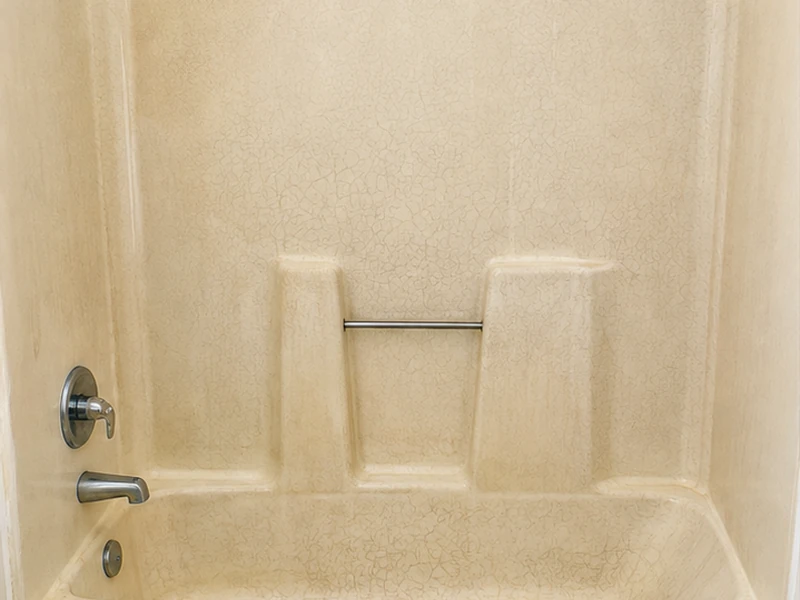
Fiberglass and acrylic are the newer story in San Francisco bathrooms. While the Edwardians of the Richmond and Sunset still hold their original cast iron, the apartment buildings that went up across the Outer Sunset, the Excelsior, SoMa and parts of the Mission in the 1970s and 1980s were fitted with one-piece molded fiberglass tub-and-shower units. Four decades on they show their age predictably: the gelcoat yellows, fine spiderweb crazing creeps across the floor and walls, and no amount of scrubbing brings back the shine.
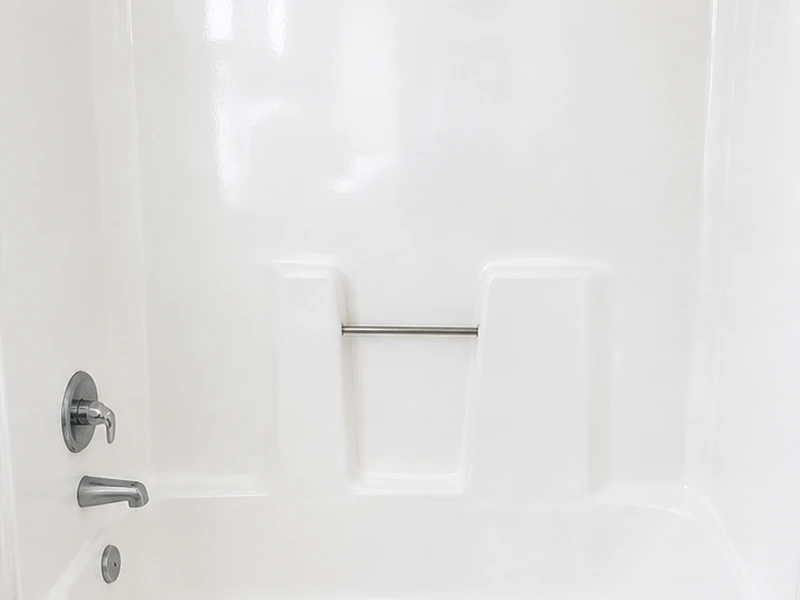
That gelcoat is the molded outer resin layer, and once it dulls and crazes there is nothing underneath to polish back to. Refinishing rebuilds the surface. We scuff-sand the gelcoat to give it tooth — fiberglass is never acid-etched the way porcelain is — lay down an adhesion promoter, and spray a fresh acrylic-urethane topcoat. A yellowed, chalky unit comes back to clean even white, harder and easier to clean than the original gelcoat ever was.
Acrylic flexes slightly, so a rigid finish would crack the first time someone steps in. We prep it with a solvent wipe and a flexible bonding coat so the topcoat moves with the substrate. It is the logic landlords in Glen Park and Potrero Hill care about: a finish that survives real tenants, not a coat that peels by the next lease.
The biggest reason fiberglass refinishing wins here is the one-piece unit problem. You cannot pull a molded tub-and-shower out without cutting it apart and tearing into the wall, which turns a cosmetic fix into a full demolition. Refinishing leaves the wall, plumbing and tile alone — and if the floor flexes underfoot, we reinforce the base first, because a finish over a flexing floor fails no matter who sprays it.
Fiberglass and acrylic refinishing questions, answered
Why do fiberglass and acrylic tubs fade, yellow and craze?
The gelcoat — the molded outer resin layer — breaks down with UV light, hot water and years of cleansers. It loses its shine, yellows, and develops crazing: fine spiderweb cracks across the floor and walls. There is nothing under the gelcoat to polish back to, so refinishing rebuilds the surface.
Gelcoat is a thin resin skin. In the 1970s and 1980s units common across the Outer Sunset, the Excelsior and SoMa, that skin is now four decades old. Hot water and scouring products wear it chalky, which is why a yellowed unit never scrubs back to white. Crazing is the next stage — once the brittle resin cracks in a fine spiderweb, polishing does nothing, and the only fix is to scuff it back and spray a new bonded topcoat.
My fiberglass tub floor flexes — can that be fixed before refinishing?
Yes, and it has to be. A soft, trampoline-feeling floor means the unit was never fully bedded underneath during install. We reinforce the base from below or fill the void with a rigid backer or pour-in foam first. A topcoat sprayed over a moving floor will crack no matter how good the prep is.
This is the most important check on a fiberglass tub, and the one DIY kits ignore. If the floor gives like a drum head, the molded shell is spanning an air gap, and a hard finish sprayed over it cracks the first time someone steps in. The fix is structural, not cosmetic — we shore the base so it stops moving, then refinish over a solid floor that will hold the coat.
Can spider cracks and stress cracks be repaired?
Yes. Fine crazing is sanded back and sealed under the new topcoat. Open cracks or stress cracks wider than about ¼ inch, and any small hole, get fiberglass mesh reinforcement and filler first, then the area is refinished so it reads as one smooth surface.
Not all cracks are equal — hairline crazing disappears under a bonded coat, while a wider stress crack goes through the gelcoat and needs structure behind it first. Here is the rule we work to:
- Crazing / hairline spiderweb: scuff-sand, seal, refinish — no mesh needed.
- Stress crack wider than ¼ inch: grind out, fiberglass mesh + filler, then refinish.
- Small hole or puncture: back-reinforce, fill flush, refinish over it.
- Flexing floor under the crack: reinforce the base first, or the crack returns.
Fiberglass vs acrylic — does the prep differ?
Yes. Both are scuff-sanded for tooth, never acid-etched — acid is for porcelain. Fiberglass takes an adhesion promoter then the topcoat. Acrylic flexes slightly, so it gets a flexible bonding coat under the topcoat so the finish moves with the material instead of cracking.
| Material | Prep | Why |
|---|---|---|
| Fiberglass / gelcoat | Scuff-sand + adhesion promoter + acrylic-urethane topcoat | Rigid shell; tooth + promoter is enough to bond |
| Acrylic | Solvent wipe + scuff + flexible bonding coat + topcoat | Material flexes; rigid coat alone would crack |
| Either, with a flexing floor | Reinforce base first, then prep as above | A moving floor cracks any finish |
Acid etching is the wrong tool on both — etch belongs on glassy porcelain enamel, not gelcoat or acrylic. Anyone offering to acid-etch your fiberglass tub does not know the material.
When is a fiberglass tub too far gone to refinish?
When the shell itself is thin, brittle and failing — a floor cracked clean through, walls you can flex with two fingers, or a unit so degraded the substrate crumbles. At that point a coating has nothing solid to bond to, and replacement is the honest call. We will tell you when that is the case.
Most units we see are sound shells with a worn surface, and those refinish well. The exceptions are real, though. Some bargain-grade 1970s units were molded thin, and forty years of UV and water leave the resin weak throughout, not just on top. If the floor is cracked across its span, the walls deflect under light pressure, or the laminate is delaminating, no finish will save it. We would rather lose the job than sell a refinish that fails, and we will say so when we see it.
Why is a DIY fiberglass spray kit riskier than it looks?
Two reasons, and neither is obvious from the box. The first is adhesion: fiberglass cannot be acid-etched, so a kit that does not properly scuff-sand and prime the gelcoat will peel — the failure AJ Dankins gets called to fix most often on these units. The second is the chemistry. A real two-part acrylic-urethane cures through isocyanate cross-linking, and while that reaction is active it gives off vapor that is a respiratory sensitizer — the kind of compound California's Proposition 65 exists to flag.
We control that exposure with supplied-air or properly rated respirators for the sprayer, mechanical ventilation pulling air out of the work zone, and a contained 24–48 hour cure before anyone re-enters. The coating itself is a low-VOC formulation meeting California Air Resources Board (CARB) limits under Bay Area Air Quality Management District (BAAQMD) rules, sprayed with HVLP equipment that lands more material on the tub and puts less mist in the air. A homeowner spraying a two-part coating in an unventilated apartment bathroom has none of that protection, which is the part of this trade that genuinely calls for training and gear.
Can you refinish a fiberglass tub-and-shower combo?
Yes, and it is one of our most common San Francisco jobs. We scuff-sand and refinish the tub base and the molded wall surround together so the whole unit reads as one even surface, from $949. Matching the surround to the tub is the point — a refinished base under a dingy surround looks half-done.
One-piece combos are everywhere in the city's apartment stock, and tearing one out means cutting into the wall behind it. Refinishing the full unit — base, walls and soap niche — in one visit refreshes the whole shower without touching the plumbing or drywall. If tiled areas sit above the surround, those reglaze in the same color; see the shower refinishing page for surround and pan work.
San Francisco before & after
San Francisco customer reviews
Our molded fiberglass unit in the Excelsior was yellow and crazed all over. No way to replace it without gutting the wall. They sprayed it white and it looks like a new tub. Done in one afternoon.
— Phuong L., The Excelsior
The acrylic tub in our SoMa loft had scratches everywhere. They explained why acrylic needs a flexible coat and the finish is dead even now. No cracking after a year of daily use.
— Andre M., SoMa
I manage units in Potrero Hill and the tub floors were flexing. They reinforced the bases before spraying so the finish would hold. Tenants are happy and so am I.
— Renee D., Potrero Hill
Fiberglass & acrylic tub FAQ
What is crazing and can it be fixed on a fiberglass tub?
Crazing is the fine spiderweb cracking in old gelcoat, common in 1970s and 1980s San Francisco apartment units. We sand it back, fill where needed, and spray a fresh topcoat so the surface reads smooth again.
How do I care for a refinished fiberglass tub?
Use a non-abrasive liquid cleaner and a soft cloth, and avoid suction-cup mats and scouring pads. A professional finish cared for this way lasts 10–15 years, versus 2–4 years for a DIY spray kit.
Is the work licensed, insured and warrantied?
Yes. SF Bathtub Reglazing Specialists is fully licensed and insured, and every fiberglass and acrylic refinishing job carries a written 5-year warranty covering adhesion and finish defects under normal use.
Why do DIY spray kits peel on fiberglass tubs?
DIY kits skip the scuff-sand and adhesion promoter, so the coating never grips the slick gelcoat and lifts within 2–4 years. Proper prep plus a sprayed acrylic-urethane topcoat is what makes a finish bond and last.
My fiberglass tub floor feels soft — can it still be refinished?
Yes, but the base has to be reinforced first. A soft, trampoline-feeling floor means the unit was never fully bedded during install. We shore it from below with a rigid backer or pour-in foam, then refinish, because a coat over a flexing floor cracks.
When is a fiberglass tub not worth refinishing?
When the shell itself is failing — a floor cracked through, walls that flex with light pressure, or a unit so degraded the substrate crumbles. A coating needs something solid to bond to. In those cases we recommend replacement rather than a finish that will fail.
Refinish your San Francisco fiberglass tub
Mon–Fri 8 AM–6 PM, Sat 9 AM–4 PM. Fully licensed & insured.